Corporate Underwriters and the Democracy Gap
How company political spending has reshaped state politics and created…


CPA at 20: Norm Changer
CPA at 20:
Norm Changer
How company political spending has reshaped state politics and created…
First Hard Look at Business’ Stake in Democracy, How…
Seventy-Five Leading Public Companies Undercut Their Climate Change Commitments Through…

See the Guide to Corporate Political Spending.

See the Primer on Corporate Political Spending for incoming Directors.
CPA at 20: Norm Changer
CPA at 20:
Norm Changer
How company political spending has reshaped state politics and created…
First Hard Look at Business’ Stake in Democracy, How…
Seventy-Five Leading Public Companies Undercut Their Climate Change Commitments Through…
See the Guide to Corporate Political Spending.
See the Primer on Corporate Political Spending for incoming Directors.

Why Corporate Treasury Spending Matters: The Hidden Iceberg
Read the Fact Sheet >>

Why Corporate Treasury Spending Matters: The Hidden Iceberg
Read the Fact Sheet
 Looking Behind the Curtain: Corporate due diligence of political spending essential to protect companies from growing risks
Looking Behind the Curtain: Corporate due diligence of political spending essential to protect companies from growing risks
Read the Article >>

Under the Radar: The Unrecognized Importance of 527 Committees
Read the Explainer >>
Under the Radar: The Unrecognized Importance of 527 Committees
Read the Explainer >>
The Corporate
Underwriter Series
How does
your company
rank?
Do you
have the 2023
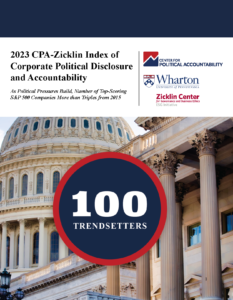
CPA-Zickin Index?
The Corporate Guide
to Political
Spending
How does
your company
rank?
Do you
have the 2023
CPA-Zickin Index?
CPA In the News

There’s a noticeable trend in the S&P 500 towards political disclosure and accountability becoming the norm, with a significant percentage of companies scoring high on the CPA-Zicklin Index of Corporate Political Disclosure and Accountability.

Freed told Popular Information that the corporations sending millions in PAC donations to election deniers are “putting themselves at risk.” He thinks the companies are underestimating the economic danger of undermining “the rule of law.” Instead of focusing on the preservation of “the political system that they need to be able to operate and grow,”…

A rush of shareholder proposals demanding transparency have been filed for the 2024 proxy season, with a strong emphasis on lobbying alignment.

With corporate political disclosure and accountability accepted as the norm, the next step for companies is to put in place a framework for approaching, governing and assessing their election-related spending.

The vast majority of companies utilize various forms of public policy advocacy to impact legislative and regulatory decisions mainly through lobbying and campaign contributions.

“Now, the CPA has developed a Guide to Becoming a Model Code Company, designed to help companies and their boards understand the Model Code and how it can help them manage election-related political spending in high-risk environments…”

Three fundraising accounts tied to key Michigan Democrats each got contributions of at least $200,000 from a nonprofit bankrolled by one of the state’s largest electric utilities in 2022, according to a tax filing obtained by The Detroit News.

Big brands like Comcast, Walmart, Pfizer, and AT&T fund the ring-wing political group that wrecked our democracy.

“They’ve reverted to spending as usual, and they are engaging in spending for access.”
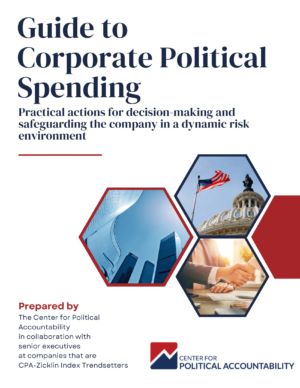
As we begin this new year—a highly charged election year—it might be helpful to check out the Guide to Corporate Political Spending produced by the non-partisan Center for Political Accountability.

The number of public corporations in the S&P 500 Index getting scores of 90 percent or better, called Trendsetters, jumped from 89 last year to a record 100 now, according to data in the 2023 CPA-Zicklin Index of Corporate Political Disclosure and Accountability.
One fifth of S&P 500 firms rank as ‘trendsetters’ in 2023 CPA-Zicklin Index of Corporate Political Disclosure and Accountability…

One fifth of S&P 500 firms rank as ‘trendsetters’ in 2023 CPA-Zicklin Index of Corporate Political Disclosure and Accountability.

As the U.S. continues to look polarized politically, a growing number of S&P 500 companies have made the effort to earn the highest scores from a watchdog organization that’s focused on transparency in corporate political spending.

The Center for Political Accountability recently published this 10-page guide to corporate political spending. The guide suggests solutions to 5 common challenges that arise from contributions to political candidates, trade associations, and other third-party groups.
The purpose of the Guide is to help safeguard companies as they make political spending decisions in today’s charged environment.

Today members of the Interfaith Center on Corporate Responsibility (ICCR) announced they had sent letters to members of the Business Roundtable urging them to align political spending with their state core values, to mitigate both reputational risks to the company, and broader risks to democracy.

Corporations increasingly face risk from their political spending, and that risk is heightened when they have not charted where funds will actually go.

“The whole issue of dark money and soliciting dark money presents a real crisis in our political system today and poses a real risk to companies,” said Bruce Freed, president of the Center for Political Accountability, a Washington, D.C., group that pushes companies to disclose more about their financing of political efforts. “At this point,…

Bud Light. Disney. Goya. Coca-Cola. Delta. The one thing these companies all have in common is they have all found themselves in the crosshairs of American politics.
Find out how we achieve unparalleled success.

Receive our monthly newsletter.

Contribute to our important work.

Find out how we achieve unparalleled success.
Receive our monthly newsletter.
Contribute to our important work.